

In our latest subscriber chat, we explored the experiences of those working in some of the UK’s most remote & rural communities, and heard examples of the daily challenges they face in terms of promotion, the solutions they’re trying, and the service changes made possible through Care Opinion feedback.
From the Western Isles to Northern Ireland to Devon and Orkney, the session highlighted just how powerful Care Opinion can be when it’s brought right to where people live, work and receive care.
We were joined by a fantastic panel of speakers:
- Denise Symington, NHS Western Isles
- Colin Patterson, South Eastern Health & Social Care Trust
- Jaimie Cooper, NHS Orkney
- Michael Craddock, Royal Devon University Healthcare NHS Foundation Trust
Each of them generously shared their experiences, practical ideas and reflections on promoting Care Opinion in their own rural and remote areas.
But what does “remote and rural” really mean, in terms of health & care? In some places, people travel over an hour just to reach urgent care. In others, like the Isle of Barra, the entire population is around 1,000 people - which makes anonymity a real concern for both patients and staff.
There’s no single, universal definition of a remote or rural community in healthcare planning, but in Scotland it’s generally understood as:
“small populations and long travel times to reach urgent care - over 30 minutes for primary care and over 60 minutes for emergency or specialist services." Royal College of Nursing
A clear example is the Isle of Barra, with a population of around 1,000 people. While urgent care is available locally at St Brendan’s Hospital, accessing specialist urgent or emergency care can mean several hours of travel by ferry or air transfer.
These realities create unique challenges for services, but they also underline how vital patient feedback is in shaping the future of health and care in remote areas.
With that in mind, we asked our panel to reflect on what’s working well, where improvements are needed, and to share their ideas for reaching rural and remote communities more effectively.
Care Opinion Goes Where the People Are
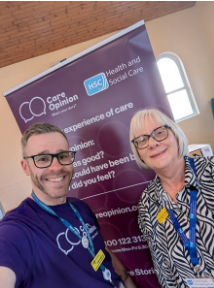
One of the highlights of the session came from Colin Patterson - South Eastern Health & Social Care Trust, who shared how he and his team stepped outside traditional healthcare settings and into the heart of rural life to encourage more people to share their stories via Care Opinion.
They joined a multi agency community event spanning Dromore, Dromara and Banbridge - areas where people often cross trust boundaries just to access care. Instead of waiting for feedback to come to them, they took Care Opinion to the community. Colin described how the event:
“reduced that institutional feel… this wasn’t a healthcare environment,”
And it worked! People stopped, chatted, shared what mattered to them, and left withCO branded tote bags, pens and a sense that their voice would genuinely be heard. It was grassroots engagement at its best - warm, visible and human.
A Flyer, A Smile, and a 600% Increase in Stories!
Over in Royal Devon, Michael Craddock showed how simple actions can create huge momentum.
Their approach? Staff hand out A5 flyers with a warm personal invitation to share feedback.
Not a pile of leaflets on a desk. Not just a poster hung on a wall. A human moment.
Michael said:
“a flyer handed out with a personal invitation to give feedback just gets good results for us.”
The numbers speak for themselves! Story volumes have jumped from just 7 in a quarter to an impressive 49 (so far!).
Staff are changing the way they encourage feedback through Care Opinion, and with support from Michael and his team, more voices from remote and rural communities are being heard.
With this new volume, Eastern Community Services can now run AI supported thematic analysis, triangulate with complaints and PALS, and feed insights directly into governance meetings. Before this? There simply wasn’t enough feedback to make that possible.
To support staff even further, Michael’s team created their own internal Care Opinion training - brief, practical summaries that make it easy for busy frontline staff to get up to speed. It’s proving to be a really effective way to boost awareness, confidence and engagement throughout teams and services!
One Story That Changed a Service
Then came a great example from Denise at NHS Western Isles, showing how even a single story can make a significant difference!
Their podiatry team had been struggling for some time with unsuitable clinic space. Patients were mentioning informally that access was difficult, but the team needed a clear way to gather and evidence this feedback to strengthen their case for change.
Care Opinion provided exactly that.
Denise explained that the team were able to use the feedback that they got through Care Opinion to actually make it part of their business case.
The outcome was a win for both patients and staff: they secured a dedicated podiatry clinic space - the first of two - directly supported by patient stories via Care Opinion!
It’s a powerful reminder that critical stories don’t just highlight problems, they can support solutions!
Small Teams, Big Wins
From NHS Orkney, Jaimie shared a lovely example of how even one story can lift a whole team.
After attending a staff awareness session, an audiologist decided to try handing out QR codes inviting feedback via Care Opinion “just for a day.”
Three weeks later, a glowing story came in - about them!
For a small service, that kind of feedback is gold. It boosts morale, validates hard work, and shows that even tiny teams in remote places can make a big impact.
Read the full story here: The Audiologist was excellent
What We Learned
Across the conversation, three themes kept coming up:
1. Keep it simple
A flyer, a QR code, a friendly invitation - these small touches make feedback feel accessible.
2. Make it personal
People respond to people. Not posters or flyers. A smile and friendly ask can make all the difference!
3. Use stories as evidence
Whether it’s a business case for clinic space or identifying themes across a region, Care Opinion stories are powerful data.
A Huge Thank You!
To Denise, Colin, Jaimie and Michael - thank you for giving your time and sharing your experiences so openly. Your work shows that remote communities aren’t impossible to reach. They just need the right approach, the right tools, and the right people championing Care Opinion across the organisation.
And to everyone who joined the session, we hope you left feeling energised, inspired, and ready to try something new!
Subscriber Chat Resources:
Session Slides: Remote communities slides.pdf
Colin's Blog: Engaging across rural communities
Royal Devon Blog: Care Opinion coding
Watch the recording:
Promoting Care Opinion in Remote Communities: Big Impact From Small Places
Promoting Care Opinion in Remote Communities: Big Impact From Small Places https://careopinionuk-staging.azurewebsites.net/resources/blog-resources/41-images/052b8b9d2d9e4406b54c6491ecd58b2e.png Care Opinion 0114 281 6256 https://www.careopinion.org.uk /content/uk/logos/co-header-logo-2020-default.pngUpdate from Subscriber Support Team
Posted by Danielle McEwan, Senior Subscriber Support Officer, Subscriber Support Team, on
Thanks for your feedback.