

Recently, I had the privilege of speaking at the Realistic Medicine Conference in Glasgow. It was a brilliant event, full of people thinking seriously about how health and care can be more careful, more personal, and more closely connected to what people actually value.
That, for me, is the power of Realistic Medicine. It asks us to begin not with the system, the pathway or the available treatment, but with the person in front of us. What matters to them? What are they hoping for? What are they worried about? What would good care look and feel like in the context of their life?
That sounds simple, but anyone working in health and care knows it is anything but. Our systems are busy, pressured and often measured by the things that are easiest to count: waiting times, appointments, activity, processes, costs and targets. All of those things matter, of course they do. But they do not, on their own, tell us whether care is working for people.
Realistic Medicine asks something deeper of us. It asks us to support shared decision making, reduce harm and waste, manage risk better, and build care around people rather than asking people to fit around systems. It asks us to understand value from the perspective of the person receiving care, not just from the perspective of the service delivering it.
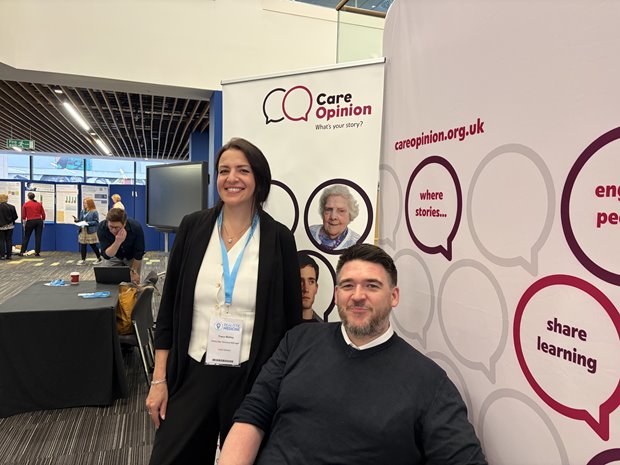
Care Opinion also had a stall at the conference, and our team had a great time speaking to NHS staff from across Scotland. What struck me was how many of those conversations came back to listening: How do we hear from people in ways that help us understand what they really value in their care?
That question matters because Realistic Medicine has to be more than language we agree with. It has to be felt in everyday care. It shows up when someone feels involved in a decision, when they are given information they can understand, when their worries are taken seriously, when care feels coordinated rather than fragmented, and when a conversation makes space for what matters to them, not just what is the matter with them.
There are many routes into that understanding: conversations with clinicians, shared decision making, local engagement, complaints, surveys, involvement work and relationships with communities. All of these matter. Care Opinion is one such route into that understanding, and I would argue a powerful one.
Through Care Opinion, people share their experiences of health and care in their own words. Those experiences are moderated, published and sent to the relevant services, so staff can listen and respond. What this creates is a visible exchange between people using services and people delivering them. Feedback is not simply gathered somewhere in the background. People can see that they have been heard.
For staff and services, this offers insight that is difficult to get from activity data alone. It helps show whether people felt involved, reassured and respected. It can show where communication worked well, where kindness made a difference, and where continuity helped someone feel safe. It can also show where the system made things harder than they needed to be.
In Scotland, Care Opinion works with all territorial and special health boards, as well as 13 Health and Social Care Partnerships. Last financial year, 12,464 stories were shared on Care Opinion about health boards in Scotland, with more than 14,514 responses from staff. Those numbers matter, but the real value is in what those experiences help us understand.
They help us see where the principles of Realistic Medicine are already being put into practice: where people feel involved, where options are explained clearly, where care feels thoughtful, kind and personal. They also help us see where there is more to do: where people feel lost in the system, where decisions are not shared, or where care feels confusing and fragmented.
And this is not only about learning from what goes wrong. Positive feedback has real value too. When someone describes care that made them feel safe, respected, informed or involved, there is learning in that. It helps us understand the conditions that allow good care to happen, and how we might create more of them.
That is why patient voice matters so much to Realistic Medicine. Not because public feedback is the whole answer, but because it helps us test whether the principles are being experienced in practice. It helps us move from asking only what care was delivered, to asking what that care meant for the person receiving it.
If Realistic Medicine asks us to focus on care that is right for the person, then listening to people has to be part of how we know whether we are getting there. Value in health and care is not found only in the treatment offered, the appointment delivered or the pathway completed. It is also found in whether people felt listened to, whether decisions made sense in the context of their lives, and whether care helped them in the ways that mattered most.
That is the promise of Realistic Medicine. And it is why listening to people, properly and consistently, has to remain at the heart of it.
Realistic Medicine starts with listening
Realistic Medicine starts with listening https://careopinionuk-staging.azurewebsites.net/resources/blog-resources/0-images/a73785cae5674ce4adb07d591cfe7024.jpg Care Opinion 0114 281 6256 https://www.careopinion.org.uk /content/uk/logos/co-header-logo-2020-default.pngUpdate from Care Opinion
Posted by Fraser Gilmore, Chief Executive Officer, Care Opinion, on
Thanks for your feedback.