

Blog 1 of 3 - What stories tell us about care series
Every story shared on Care Opinion begins with someone deciding that their experience matters.
They may be writing because a member of staff made them feel safe when they were frightened, took time to listen when they felt vulnerable or showed kindness at a moment when it was most needed. Others write because care did not work as they hoped, because they were left without information or because they want their experience to make things better for the next person.
Whatever brings someone to Care Opinion, sharing a story is an act of generosity. It means returning to an experience, finding the words to describe it and offering those words to the people who provide, lead and shape our health and care services.
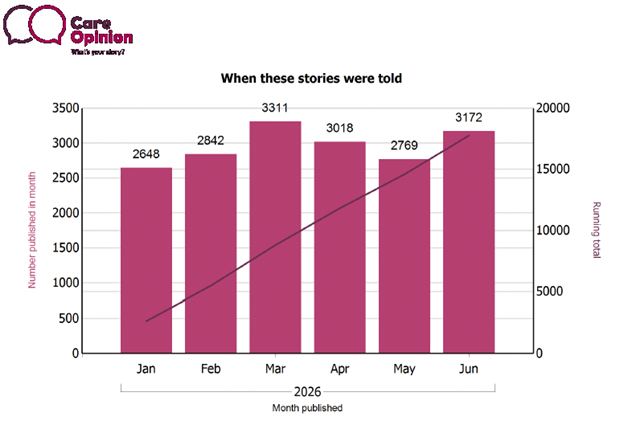
During the first six months of 2026, members of the public shared 17,760 stories on Care Opinion about health and care services across the UK. Those stories have been read 1,143,509 times.
Behind these figures are thousands of experiences of kindness, relief, uncertainty, frustration, gratitude and hope. Together, they provide a rich picture of what care looks and feels like from the perspective of the people receiving it.
This is the first in a three-part series exploring what these stories, shared on Care Opinion in the first 6 months of 2026, can teach us. This blog looks at what people told us about good care. The second will consider what we can learn from critical experiences, while the final blog will explore the wider power of public voice and what it means for services to listen and respond.
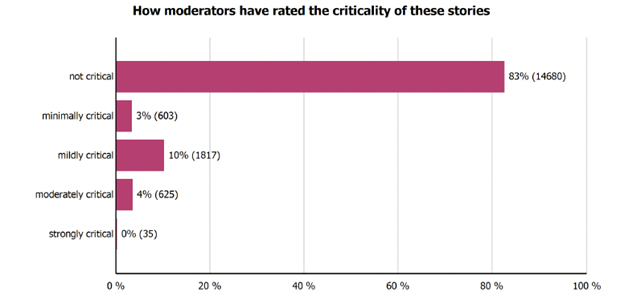
Of the stories shared during the first half of 2026, 83% were completely positive. It can be easy to view positive stories simply as compliments or expressions of thanks. They are certainly that, and we know how much those messages can mean to staff, but they also offer something more.
Positive stories show us what people value. They reveal the relationships, behaviours and moments that make care feel compassionate, safe and human. They help services understand not only that something went well, but why it mattered to the person receiving care.
The words most commonly chosen by authors to describe what was good about their experience were staff, helpful, care, kindness, friendly, professional, nurses, caring, great team and communication.
People notice clinical skill and professionalism, but they also notice warmth, helpfulness and teamwork. They remember when somebody explained what was happening, reassured them or helped them feel that they mattered. These are not small details surrounding the delivery of care. They are part of the care itself.
Authors were also invited to describe how their experience made them feel. The words and phrases selected most often were thankful, supported, grateful, reassured, cared for, listened to, informed, comfortable, thank you and put at ease.
As most stories shared during this period were positive, it is unsurprising that positive feelings appeared most frequently. Even so, they tell us something important about what good care achieves. Feeling listened to can give someone confidence to explain what is really happening. Feeling informed can help a person understand uncertainty and participate in decisions. Feeling reassured can transform an experience that might otherwise have been frightening or overwhelming.
People experience care emotionally as well as clinically. They remember what happened, but they also remember how they were treated and how it made them feel. Stories capture this meaning in a way that a score or survey response often cannot.
Health and care organisations rightly spend time investigating what has gone wrong, but there is equal value in understanding why something went well. Positive stories can help teams recognise good practice, understand the conditions that make it possible and reinforce it across services.
The public is telling us, in thousands of different ways, what good care feels like. The opportunity is not simply to receive their appreciation, but to learn from it and ensure that the practice behind it is recognised, encouraged and allowed to grow.
What good care feels like: Learning from 17,760 stories
What good care feels like: Learning from 17,760 stories https://careopinionuk-staging.azurewebsites.net/resources/blog-resources/0-images/926a79cef673469baf4ca7c256090bc2.png Care Opinion 0114 281 6256 https://www.careopinion.org.uk /content/uk/logos/co-header-logo-2020-default.pngUpdate from Care Opinion
Posted by Fraser Gilmore, Chief Executive Officer, Care Opinion, on
Thanks for your feedback.