

Blog 2 of 3 - What stories tell us about care series
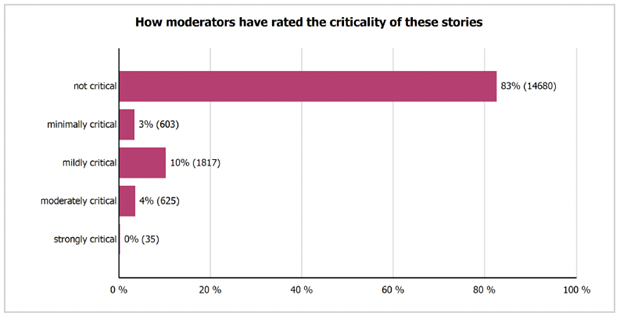
During the first six months of 2026, members of the public shared 17,760 stories on Care Opinion about health and care services across the UK. While 83% were completely positive, 17% contained some level of criticality.
In the first blog in this series, I explored what positive stories tell us about the care people value. Critical stories offer a different, but equally important, kind of knowledge. They show us where care did not work as someone needed it to, where a process fell short or where communication made an already difficult experience harder.
The areas for improvement most commonly identified by authors were communication, staff attitude, waiting times, delays, information, lack of support, not treated, follow-up, long wait and appointments.
These themes are closely connected. Waiting is not only about the length of time someone waits, it's also about whether they know what is happening, whether anyone checks on them and whether they feel forgotten. A delay becomes harder when information is missing, while an appointment can leave someone feeling unsupported if they don't understand what will happen next.
A person may receive appropriate clinical treatment and still leave feeling dismissed, because nobody appeared to listen. Someone else may experience a long wait but feel reassured because a member of staff kept them informed, explained the situation and treated them with kindness.
Stories show us how systems, processes and human interactions come together in the life of one person. They reveal consequences that may be invisible within performance reports, and show the difference between how a service is designed to work and how it feels to someone trying to use it.
A waiting-time figure can tell us how long people waited, a story can tell us what that wait meant. It can show that someone didn't know whether they had been forgotten, that a family member didn't know who to contact or that uncertainty added to an already anxious situation.
This does not make quantitative information less important, it demonstrates why we need stories alongside it. Stories give numbers context and help services understand the human experience behind their measures.
Critical feedback can be difficult to receive, particularly when staff are working under pressure or feel they did everything they could. It's natural to want to explain the circumstances, correct details or defend colleagues. However, when defensiveness becomes the first response, the learning within the story can be lost.
A story is one person’s account of what care looked and felt like from where they stood. It may not contain every fact or reflect every pressure facing the service, but that doesn't make their experience less valuable. Listening openly doesn't require agreement with every interpretation, it means acknowledging the impact and being willing to consider whether something could be understood or done differently.
Not every critical story will lead to a redesigned pathway or a formally recorded service change, many will have a quieter impact. A story may shape a team discussion, influence how someone communicates with the next patient, prompt a review of a letter or help a leader recognise a recurring problem.
These changes are difficult to count, but they matter. Culture often shifts through one conversation, one reflection and one decision at a time.
Positive stories show services what should be recognised and reinforced. Critical stories reveal where care could be better. We need both if we are to develop a full and honest understanding of people’s experiences.
Critical stories invite us to look beyond our own view of how a service works and see it through the eyes of someone using it. That can be uncomfortable, but when met with curiosity and openness, it can also be the beginning of meaningful learning and change.
An invitation to see differently: What critical stories can teach us
An invitation to see differently: What critical stories can teach us https://careopinionuk-staging.azurewebsites.net/resources/blog-resources/0-images/26bbf90724054a3bbf5dbaf60851e21f.png Care Opinion 0114 281 6256 https://www.careopinion.org.uk /content/uk/logos/co-header-logo-2020-default.pngUpdate from Care Opinion
Posted by Fraser Gilmore, Chief Executive Officer, Care Opinion, on

Thanks for your feedback.