

Blog 3 of 3 - What stories tell us about care series
During the first six months of 2026, members of the public shared 17,760 stories on Care Opinion about health and care services across the UK. Those stories were read 1,143,509 times and received 19,073 responses from services.
These figures show the scale of the conversation taking place, but they do not fully explain its importance. Behind every story is someone deciding that an experience is worth sharing. Behind every read is someone choosing to pay attention. Behind every thoughtful response is the possibility of recognition, learning and change.
In the first two blogs in this series, I explored what positive and critical stories can teach us. This final blog considers the wider power of public voice and what it means for services, policymakers, educators and researchers to listen.
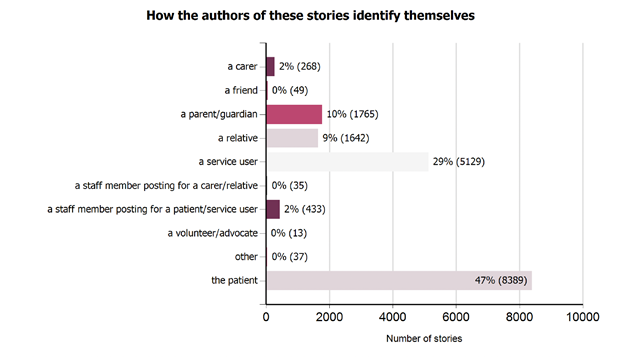
Of those sharing stories, 76% described themselves as the patient or service user. Parents and guardians accounted for 10%, 9% were relatives, 2% were carers and a further 2% were members of staff helping a patient to share their experience. The remainder came from friends, volunteers, advocates and staff writing on behalf of carers or relatives.
Care is rarely experienced by one person alone. Families, friends and carers often help people navigate services, understand information, make decisions and cope with uncertainty. Their stories help us understand the wider impact of care on the people surrounding a patient or service user.
At the same time, more than three quarters of the stories were shared directly by patients and service users. These were people describing their experiences in their own words, rather than having their voices translated into a score, category or summary written by someone else.
There is real power in that directness. The public should not simply be the subject of conversations about improving care. People should be active participants in those conversations, with their experiences recognised as a vital form of knowledge.
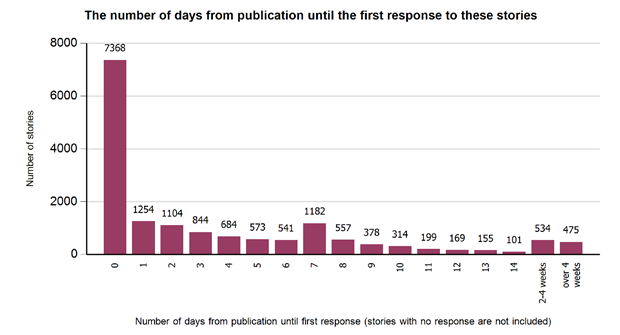
Sharing a story also requires trust, which makes the response it receives important. During this period, services responded to stories 19,073 times. So far, 92% have received a response, with 76% responded to within seven days.
A response cannot change what has already happened, but it can influence what happens next. It can ensure that appreciation reaches staff, acknowledge a difficult experience, offer an explanation or describe what has been learned. Most importantly, it can show an author that their words did not simply disappear into a system.
For services already using Care Opinion, these figures provide an opportunity to reflect and benchmark. Response rates and response times matter, but the quality of the response matters too. It should feel as though it has been written by one human being to another, showing compassion, curiosity and a willingness to learn.
The value of these stories also extends beyond individual services. For policymakers, they reveal how decisions and system pressures are experienced in wards, clinics, care homes and people’s homes. For educators, they offer a way to learn directly from the public about communication, compassion and power. For researchers, they provide rich insight into patterns and experiences across health and care.
However, the value of stories lies not only in the themes that can be extracted from them. It is also found in their detail, complexity and meaning. A story can be counted and analysed, but it should never be stripped of the humanity that made it worth sharing.
The public’s voice is not an addition to the evidence used to improve services. It is evidence. It carries knowledge that cannot be found anywhere else, because only the person receiving care can tell us what that experience meant to them.
People are already telling us, in their thousands, what compassionate care looks like and where services are falling short. The question is whether we are prepared to listen with the seriousness and humanity their stories deserve, and whether we will allow what we hear to shape the care that comes next.
When the public speaks, who is listening?
When the public speaks, who is listening? https://careopinionuk-staging.azurewebsites.net/resources/blog-resources/0-images/b409ff9095a043af899d158793dcf4ef.png Care Opinion 0114 281 6256 https://www.careopinion.org.uk /content/uk/logos/co-header-logo-2020-default.pngUpdate from Care Opinion
Posted by Fraser Gilmore, Chief Executive Officer, Care Opinion, on
Thanks for your feedback.