

A new focus is helping us think differently about how we listen to people living with dementia, their families and carers.
Every experience of care has a story behind it. But not every story is easy to tell.
For someone living with dementia, sharing an experience may not begin with filling in a form or answering a series of questions.
It might begin with someone sitting alongside them. Giving them time. Using a picture to start a conversation. Or simply being prepared to pause and listen.
That was the thinking behind our Dementia Care Opinion Workshop, held on 29 September 2026, as part of the South Eastern Health & Social Care Trust’s dementia-focused Care Opinion project.
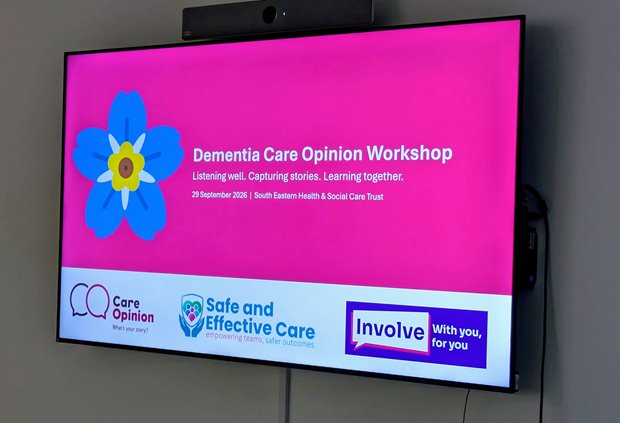
Opening slide for the Workshop Presentation
Making it easier for every voice to be heard
The project has a simple but important ambition:
To make it easier to hear experiences that might otherwise be missed.
The workshop brought together staff supporting people living with dementia, including Dementia Companions, Dementia Navigators, ward leaders and frontline staff.
Together, we explored how Care Opinion can help people living with dementia, families and carers share what care was really like, and how those stories can help us learn and improve.
At the heart of the conversation were three words:
👂 LISTEN
Create different ways for people to share their experiences and make space for the person's own voice.
💡 LEARN
Look across stories to understand what is working well and where care could be better.
🌱 IMPROVE
Respond to what people tell us, take action and show how feedback is making a difference.
What could be better? (from existing stories shared)
Listening means being prepared to hear about the difficult experiences too.
Looking at the existing 32 stories shared highlighted issues around communication, dementia-aware care, basic care and dignity, transitions and discharge, and environment and support.
One story captured the importance of coordination particularly well:
“What was missing for us was someone who could help join things together.”
Feedback like this provides an opportunity to stop and think: sometimes we need to listen differently. A central part of the workshop was thinking about the conditions we create for someone to share an experience.
For someone living with dementia, that might mean providing them with:
Quiet, Comfort, Time, Choice, Clarity
“Provide support, but do not interpret the person’s experience for them.”
That became one of the most important principles running through the workshop.
Our role is not to tell someone's story for them. Our role is to create the conditions where their story can be heard.
Examples of Dementia-focused Care Opinion promotional materials (leaflets, poster)
Using pictures as well as words
Another focus was Picture Stories, a visual feedback approach that can help people communicate an experience using pictures as well as words. Our team have developed a variety of resources to aid staff and our service users, families and carers to use Picture Stories in the right way.
We helped staff explore how pictures can help people express what matters, organise thoughts, remember important parts of an experience and provide feedback in a way that may feel less intimidating than writing a story.
On the back of this, an interactive and fun part of the workshop involved staff grouping into pairs, focusing on one of them putting themselves in the shoes of our service users to try to tell a story, while the other undertook the role of listening to that feedback in an unbiased way.
The workshop finished with a straightforward cycle:
LISTEN → RESPOND → LEARN → ACT → IMPROVE
When someone living with dementia, a family member or carer takes the time to tell us about their experience, there is a responsibility to listen, respond and use that insight to support improvement.
The project will now support a focused period of story generation through to May 2027, followed by a review of learning, impact and opportunities for wider implementation.
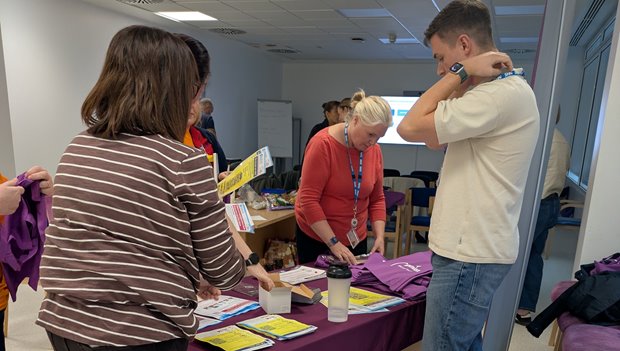
Promotional stand sharing Care Opinion promotional materials
💗 One final thought
Perhaps the most important message from the workshop is this:
We don't always need people to find better ways of giving us feedback. Sometimes we need to find better ways of listening.
That means slowing down. Being curious. Finding different ways to communicate. Giving people time. And making sure that, whenever possible, the voice we hear is the person's own. Because when we listen well, stories become more than feedback. They become an opportunity to learn, improve and make a difference.
Listening Well: Helping People Living with Dementia Share Their Stories
Listening Well: Helping People Living with Dementia Share Their Stories https://careopinionuk-staging.azurewebsites.net/resources/blog-resources/100-images/cfce994141da4d85be26d000b9843cce.jpg Care Opinion 0114 281 6256 https://www.careopinion.org.uk /content/uk/logos/co-header-logo-2020-default.pngUpdate from South Eastern Health and Social Care Trust
Posted by Colin Patterson, Governance, Involvement & Experience Lead, Safe & Effective Care, South Eastern HSC Trust, on
Thanks for your feedback.